
A friend of mine recently became father of twins. I just visited them. Well, I had my motives …
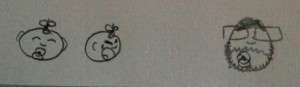
A friend of mine recently became father of twins. I just visited them. Well, I had my motives …
I was surprised. The Wind Rises is a very dark story told in bright colors.
The plot seems innocuous, but at its core is about two sick souls.
One, Jiro, is obsessed with building airplanes and has vivid “dreams” about it since he was young. He is curious and helps others, but his mind wanders around and he’s a serious workaholic. It so happens that it’s leading up to WWII and the only way to build planes is for war.
The other one, Nahoko, is revealed to be terminally ill. None the less she enjoys life painting and being mindful of the beauty of life (e.g. in the scene at the spring). As the story mostly follows Jiro there isn’t much told about her thoughts and feelings.
After meeting once during an earthquake in which Jiro helps her and her maid. They meet again many years later in a summer resort. They fall in love and get engaged.
Now the tragedy unfolds. She won’t marry him until she’s cured, he accepts. Working away he’s constantly worried, leaving work regularly to see her. She finally decides to recuperate in a alpine sanatorium, which she flees from to be with him. He’s wanted by the secret police, hiding with her in his supervisor’s home. They marry. She’s bedridden, he’s engulfed in his work. At least they’re together now. 🙂
They exists at the same time in the same place, but are worlds apart.
In this Jiro represent active, Nahoko passive destruction … Jiro man-made, Nahoko natural … Jiro outward, Nahoko inward. You can watch it eat them up little by little. The only glim of hope seems to be a few genuine moments of love, mindfully spending time with each other, fading out the world around them for a short period of time. But sadly even these moments are insufficient to overcome their sicknesses.
In the end both get consumed by them. Nahoko succumbs to her illness and dies a physical death, in a way leaving the spirit to live in the absolute, in the afterlife. Jiro on the other hand–alive in this world–dies a spiritual death having sold his soul (“ten years”) (losing his soul mate in consequence) and is trapped in the virtual, in this dream of his. She reaches out to him a last time (“You must live”), but he doesn’t understand (“Arigatou”). :'(
Both die in a way, leaving the physical world behind, but in ways that can’t be reconciled. They can’t be together, never!
Very sad and gloomy.
Among the great features of the revamped app are:
ArsTechnica has a nice quote on this:
This is the cleverest portion of the service’s revamp: make customers feel like they are sharing nothing, when in reality they are sharing everything. Passive information sharing and collection without the social friction—why didn’t anyone think of this before? The tragic, realistic answer is most likely “battery life.”
— Casey Johnston, ArsTechnica
An awesome talk with Bruce Schneier and Julian Sanchez. Asking just the right questions and giving and eyeopening view into what is possible even with todays technology.
https://youtu.be/JbQeABIoO6A
There is great commentary on how and why Facebook’s infamous “emotion study” is unethical. The main point being that the researchers and Facebook violated the “informed consent” principle of research on humans.
There have been other “individual mass manipulation” studies. e.g. you could tip the outcome of close elections by manipulating search results. But manipulating the mood of people on a massive scale is “new.” Don’t get confused, I don’t mean it like “they try to influence what we’re thinking through TV and ads.” I mean individual manipulation. Different things are manipulated in varying amounts for everyone individually … basically anything that claims “to only show you the X most relevant to you” falls into this category (especially if they don’t offer a way out of the filter bubble).
But what should we do, now that we known we have the tools to enforce emotions? Why not actually press the “button of happiness“?
Imagine if Facebook could have a button which says “make the billion people who use Facebook each a little bit happier”. It’s quite hard to imagine a more effective, more powerful, cheaper way to make the world a little bit better than for that button to exist. I want them to be able to build the button of happiness. And then I want them to press it.
My dystopian senses tell me: it will be used, but not in the way suggested above. We can probably draw some conclusions from the fact that one of the authors’ work is funded by the DoD. Why would the DoD (or any military/government organization for that matter) fund anything useful to the general good of mankind?
I see three use cases manipulating emotions:
Or to put it more eloquently:
… large corporations (and governments and political campaigns) now have new tools and stealth methods to quietly model our personality, our vulnerabilities, identify our networks, and effectively nudge and shape our ideas, desires and dreams.
[…]
I identify this model of control as a Gramscian model of social control: one in which we are effectively micro-nudged into “desired behavior” as a means of societal control. Seduction, rather than fear and coercion are the currency, and as such, they are a lot more effective. (Yes, short of deep totalitarianism, legitimacy, consent and acquiescence are stronger models of control than fear and torture—there are things you cannot do well in a society defined by fear, and running a nicely-oiled capitalist market economy is one of them).
I think netzpolitik.org put it best in their conclusion (German):
The problem that these kinds of experiments and the systems that actually enable them pose is not that they are illegal, creatively or intentionally evil. This isn’t the case even if it might feel like it.
Instead [the problem is] that they’re only a tiny step away from legitimate everyday practice. That they look a lot like ordinary ads. That they sit on top of an already-accepted construction of reality by non-transparent providers. That because of their scale and stealth they can be so efficiently and easily hidden. That they don’t devise our loss of control, but only exploit it.
The actual study: “Experimental evidence of massive-scale emotional contagion through social networks” (PDF)
Facebook wants you to help them optimize their ads. You’re supposed tell them which ones you like or dislike so they can replace the ones you didn’t like with other you might “like more.” … This seems so bizarre … In essence Facebook is telling you to curate their ad stream for you the way you curate your own content stream. In doing so they blurt out things like
giving people more control about the ads they see
and
show you the ads that are most relevant to you
Is it just me, or is this exactly the way they used to talk about content?!? o.O
All human evil comes from a single cause, man’s inability to sit still in a room.
— Blaise Pascal
N=2 is a important milestone in any empirical data set. I’ve now successfully tried two “Galaxy compatible” headphones with volume buttons with my Nexus 5 and I can now say with confidence:
All “Galaxy compatible” headphones work with a Nexus 5. 😉
I’ve actually tried the following headphones:
Both the call/mute and the volume buttons work.
Remarkable (para-)phrase attributed to French examining magistrate Marc Trévidic :
Declaring people terrorists–who are not–so they don’t become it.
This is to become the basis for new French “anti-terror” legislation.
I couldn’t find the original (French) quote, but a German translation of it.
Es gibt Leute, die man als Terroristen kennzeichnet, damit sie es nicht werden.
Which translates into something like
There’re people who get branded terrorists so they don’t become it.