
I just learned the difference between [ɯ] and [ɨ]. 😀
Yay for Wikipedia’s vowel chart with audio samples. 😀
I just learned the difference between [ɯ] and [ɨ]. 😀
Yay for Wikipedia’s vowel chart with audio samples. 😀
Fast ausgestorben. 🙁
Douglas Merrill from Google talks about what it takes to build a search engine for the web.
Besides that what strikes me as interesting is their choice of languages “focusing” (he didn’t exactly say that, but it’s what you understand, when he says they won a prize for it) their efforts in machine translation on: Arabic and Chinese … o.O
발 + 끝 = 발끝
(foot + tip/end = toe)
As found in Kim Jong Kook’s “Lovable”.
btw: stumbled on this watching old Running Man episodes. 😉
Er hot a gojischen Kopp
steht ungefähr für „Er ist dumm“.
Goi bezeichnete ursprünglich einfach Nichtjuden, kann aber wie oben, anscheinend auch pejorativ “als Hinweis auf ‘unjüdisches’,[…] lasterhaftes oder unintelligentes Verhalten” verwendet werden. 😛 So gesehen, scheint es das “jüdischen Equivalent” von Kafir zu sein; mit der Ausnahme, dass Kafir keine Konnotation bzgl. der Intelligenz einer Person hat. 🙂
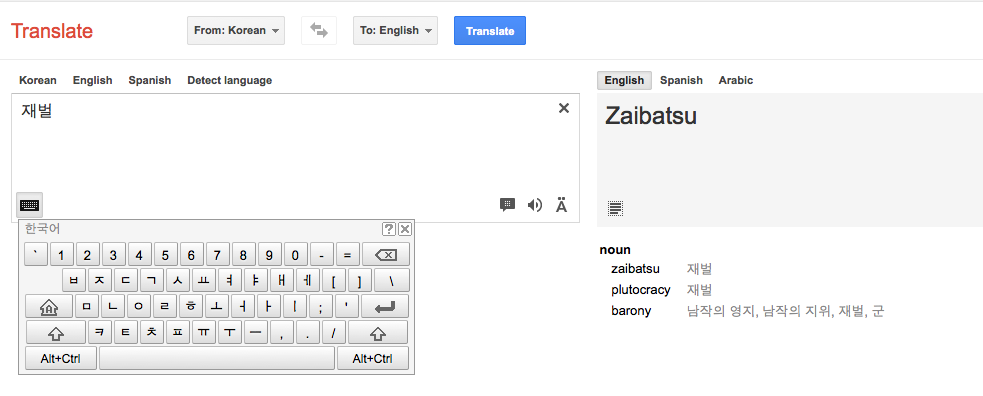
So I was reading an article on the power of big South Korean companies and wanted to look up the native word and its connotations, as I knew the Japanese had something similar called “Zaibatsu“.
So transliterating the word from the article “Chaebol” to “채볼” failed. So I searched Wikipedia for “Chaebol” at the top it said “Jaebol”. o.O So I tried “재볼” and failed again. By that time I looked in the Languages section on the Wikipedia page and learned that it was actually written “재벌“.
Well, looking up the English translation for it turned up the Japanese word. m(
눈 + 물 = 눈물
(eye + water = tears)
There are certain concepts that don’t translate well over language borders. It is difficult to convey a nuance of something to someone which she is not able to conceptually grasp (be it mentally or linguistically).
There are obvious things like Phonems (everyone loves those 😉 ) …
… and less obvious things like … colors. 🙂 The most interesting thing is that almost all languages seem to make a black<->white and a red/yellow<->green/blue distinction. I came across a Wikipedia article talking about distinguishing blue from green in language as not all of them do. Another interesting concept that was described is that in some languages it is also hard to distinguish blue from black. There are studies showing the interdependence of color concepts:
According to Brent Berlin and Paul Kay‘s 1969 study Basic Color Terms: Their Universality and Evolution, distinct terms for brown, purple, pink, orange and grey will not emerge in a language until the language has made a distinction between green and blue. In their account of the development of color terms the first terms to emerge are those for white/black (or light/dark), red and green/yellow.
– Wikipedia
😀